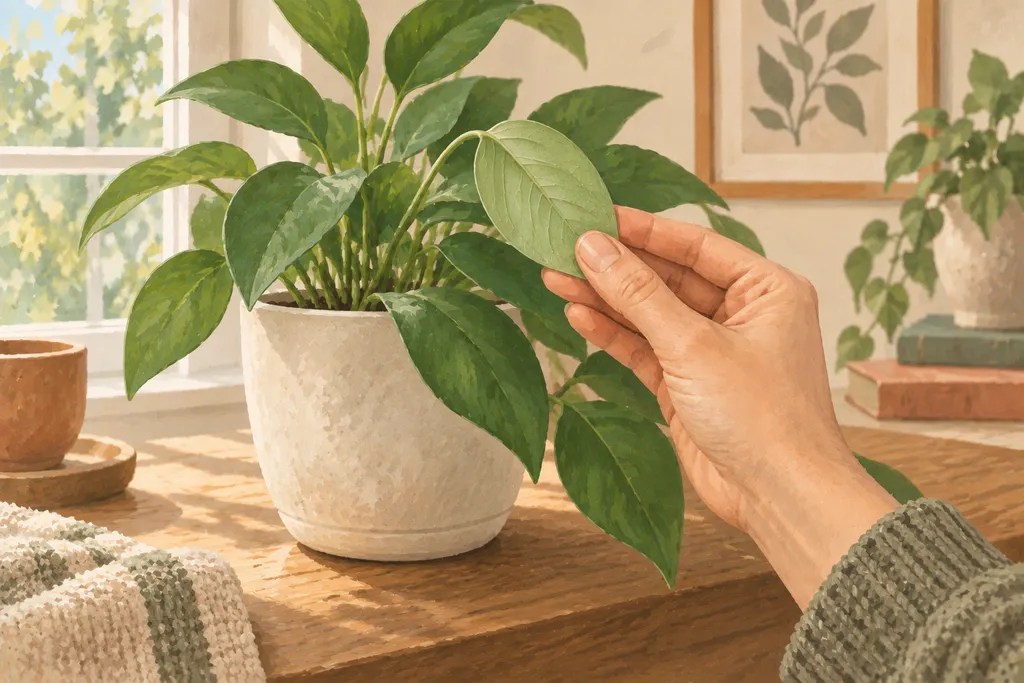
In brief
- Identification reads combinations of features — leaf arrangement, shape, margin, stems, and habit — never one trait alone.
- Learn the short vocabulary once: alternate, opposite, whorled; smooth, toothed, lobed; node and internode.
- Lookalikes and juvenile forms defeat single-feature guesses, so confirm a name against more than one trait.
- A photo tool proposes a name; plant references help you verify it before the name feeds care or safety decisions.
An unlabeled plant — a shop find, a gift, a pot you inherited — can still tell you most of what it is, if you know where to look. Botanists read the same visible features you can: how the leaves sit on the stem, what their edges do, how the plant holds itself up or trails down. The vocabulary is short and learnable, and it is the same one that keys, encyclopedias, and photo tools quietly depend on. This guide walks through the features in the order Oregon State University’s leaf-identification guide (opens in a new tab) and the NC State Extension Gardener Handbook’s botany chapter (opens in a new tab) present them — and ends with how to check a likely name once you have one.
Why names matter for care and safety
A name is a key. Once a plant has one, care guides, botanical references, and toxicity lists all open: you can find out how it prefers to live, how big it wants to get, and — if you share the house with animals — whether it should stay within reach at all. Without a name, every care question is guesswork, and the pet-safety check has nothing to run on.
A name is also a claim worth checking. “Looks like a philodendron” and “is a philodendron” are different statements, and confusing them is how plants end up in the wrong light — or on the wrong shelf. The point of learning the features is not to replace tools or references; it is to be able to verify what they tell you.
Leaf arrangement and margins
Start where the leaf meets the stem. The leaf arrangement — how leaves attach along the stem — is one of the most reliable sorting characters in plant identification. Leaves can be alternate (one leaf per node, staggered up the stem), opposite (two leaves paired at each node), or whorled (three or more circling the node). Most common houseplants are alternate, so an opposite or whorled arrangement is genuinely informative — it narrows the field quickly.
Then read the leaf itself: its overall shape (heart-shaped, oval, strap-like, lobed), and its margin — smooth and entire, toothed, or deeply divided. Oregon State’s guide treats these leaf characters as the first thing to record precisely because they are visible without equipment. See how it breaks down leaf shape and arrangement (opens in a new tab).
Stems, nodes, and growth habit
A node is the point on a stem where a leaf attaches; the stretch of stem between two nodes is an internode. Nodes are where identification lives: they carry leaf scars, buds, and on climbing plants, aerial roots. A stem with long internodes and leaves spaced far apart reads differently from a compact stem with crowded nodes — even before you look at a single leaf. The NC State botany chapter (opens in a new tab) lays out these stem structures with diagrams worth borrowing for your own notes.
Step back and take in the habit — the plant’s overall architecture. Is it trailing or climbing, upright and cane-like, a low rosette, or a dense bushy clump? Habit narrows possibilities before any leaf detail does: a rosette of stiff strap leaves points somewhere completely different from a vine with aerial roots at every node.
The stem and leaf surfaces add a second layer. Is the stem woody or soft, round or angled in cross-section, smooth or hairy? Are the leaves held on long petioles or sitting nearly flush? Turn a leaf over — the underside can differ in colour and texture from the top, and some plants hide their distinguishing features there. None of these details settles a name alone, but each one is another check a suggested name has to pass.
Flowers, variegation, and other clues
If the plant is flowering, you are holding the strongest identification evidence a plant offers — flowers carry the structures botanists use to place a plant in its family. Photograph them while they last and note their shape and colour. Most houseplants indoors will not be flowering, so the softer clues do more work: texture (waxy, leathery, soft, fuzzy, succulent), variegation patterns (splashed, margined, striped — and whether they are stable), and how new leaves emerge, tightly furled or folded.
Treat each clue as a vote rather than an answer. A waxy trailing vine with heart-ish leaves could still be two different genera; add the stem and node details, and the answer usually settles. This is also the moment to be honest about what is missing — no flowers, a juvenile form, a plant pruned into a shape it would not naturally hold. Absences are information too: a plant that has never flowered after years of good care is telling you its identity rests on foliage characters alone.
Lookalikes and why single features mislead
Plant families converge on similar shapes, and houseplants concentrate that problem: the trade favours a handful of silhouettes — trailing vines, upright canes, rosettes — produced by many unrelated species. Single features mislead constantly. Heart-shaped leaves appear on pothos, philodendrons, and several aroid cousins; the pothos-versus-philodendron guide shows how four features together settle the most famous pair. Juvenile plants make it worse — many aroids carry small, plain leaves when young and develop their characteristic shape only as they mature.
The stakes are real enough to name plainly: never use a tentative identification to decide a plant is safe to eat, medicinally useful, or harmless to a pet. Edible and medicinal use in particular needs a confirmed identity and sources beyond this site — a mistake in either direction can cause real harm.
Checking a likely name against references
Here is the loop the whole site is built around. Take one clear photo and let the plant identifier propose a likely name — common and scientific. Then verify: look the name up in a reference like the Missouri Botanical Garden Plant Finder (opens in a new tab), and compare your plant against the features you just read — arrangement, margins, nodes, habit — not against a flattering photo of someone else’s specimen.
Suppose the tool says Epipremnum aureum — golden pothos. Open the Plant Finder entry and it describes a waxy, variegated vine with a grooved petiole; now check your plant: thick waxed leaf? Shallow heart at the base? Aerial roots at the nodes? Each agreeing feature is a vote for the name; a single hard disagreement — thin matte leaves, a smooth round petiole — sends you back to the drawing board with a better question than you started with. If the named plant should have opposite leaves and yours is clearly alternate, the suggestion is simply wrong — go back to the features. If every feature you can check agrees, you have a working name worth writing down. The goal is not certainty from one afternoon; it is an honest position: “probably this, verified against these traits, worth checking again if it ever flowers.”
Takeaway: Observe the combination — arrangement, margin, stem, habit — then let a tool propose the name and let references verify it. The features are the check that never goes stale.
Sources and further reading
- Oregon State University Landscape Plants, Plant Identification: Examining Leaves (opens in a new tab)
- NC State Extension, Extension Gardener Handbook, chapter 3: Botany (opens in a new tab)
- Missouri Botanical Garden, Plant Finder (opens in a new tab)
Sources last checked 2026-09-29. Feature-based identification narrows possibilities; it does not confirm edibility, medicinal use, or pet safety — those need a verified identity and specialist sources.
Spotted an error? Tell us — include the page URL and what looks wrong.