In brief
- Pothos and heartleaf philodendron confuse nearly everyone — same family, same trailing habit, similar leaves.
- Leaf texture is the quickest tell: pothos is thicker and waxier; heartleaf philodendron is thinner, softer, and more evenly heart-shaped.
- The reliable check is the new leaf: philodendron grows one inside a protective sheath; pothos extends the stem and unfurls with no sheath.
- Both are listed as toxic to cats and dogs — whichever you have, place it out of reach.
It is the single most-confused pair in houseplants: a trailing vine with heart-ish leaves that a tag — or a shopkeeper, or a well-meaning friend — called either pothos or philodendron. Both are aroids, both vine, and they genuinely look alike in a hanging pot. But they are different plants, and four features you can see without any equipment separate them cleanly once you know where to look. This guide walks the pair feature by feature — the same approach the houseplant identification guide teaches, applied to one famous case.
Why these two get confused
Golden pothos (Epipremnum aureum) and heartleaf philodendron (Philodendron hederaceum) share a family — Araceae — and a lifestyle: fast-growing vines sold to fill the same hanging basket in the same corner of the shop. Historical naming made it worse: pothos spent decades being sold and even labelled as a philodendron, so older advice and plant tags blur the two on purpose. Add cultivars on both sides — marbled, neon, silvered — and the surface resemblance can drown the real differences.
The differences are there, and they are structural rather than cosmetic: leaf substance, petiole shape, aerial roots, and how a new leaf emerges. Check them together, not one at a time — the Missouri Botanical Garden Plant Finder (opens in a new tab) keeps entries for both species if you want a reference description to check against. One honest caveat before the list: cultivars blur everything below. A neon pothos and a lemon-lime philodendron meet in the middle, so treat colour as scenery and read the four structural features instead.
Leaf texture and shape
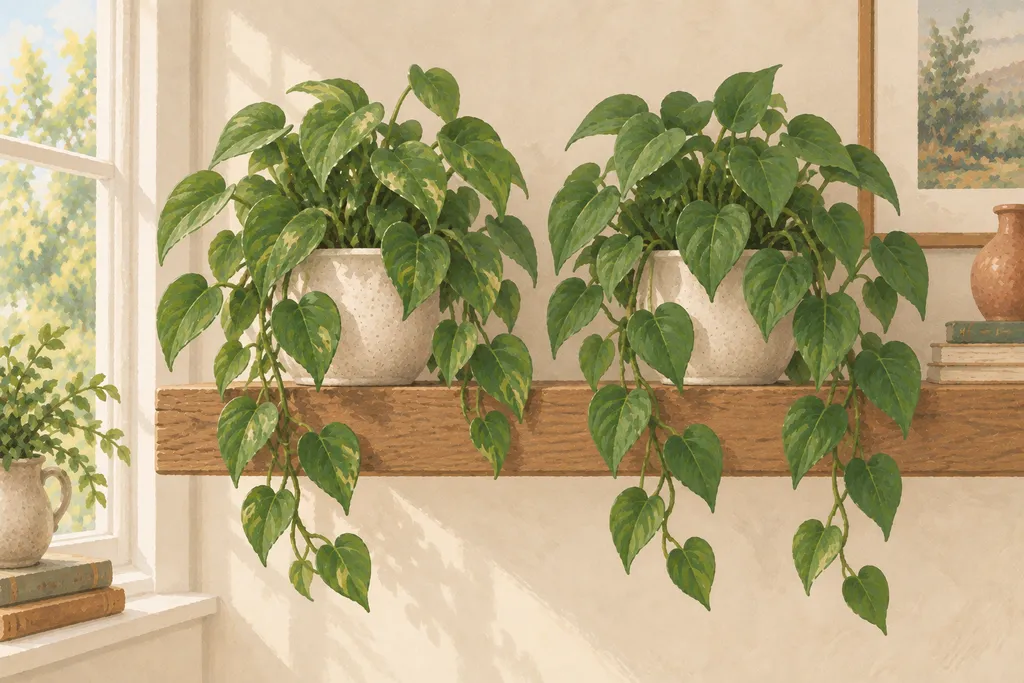
Pick up a leaf and flex it gently. Pothos leaves are noticeably thicker and waxier — they hold a shape, feel almost leathery, and often carry a sheen. Heartleaf philodendron leaves are thinner and softer, more matte, and they flop rather than spring. The shapes differ subtly too: a philodendron leaf tends to be a deeper, cleaner heart — a distinct notch where the petiole meets the blade — while a pothos leaf is usually more elongated and oval, with a shallower heart at the base.
Colour helps but cannot decide alone. Golden pothos usually shows yellow or cream variegation in marble-like splashes; heartleaf philodendron is typically an even, slightly luminous green — but a plain green pothos and a variegated philodendron both exist, so treat colour as a vote, not a verdict.
Juvenile plants blur the picture most: young pothos and young heartleaf both carry small, soft, plain-green hearts before the mature traits set in. If your plant is a recent cutting or a baby in a tiny pot, expect the leaf checks to be unhelpful for a few months and lean on the petiole and aerial-root checks instead — those stay readable while the leaf is still catching up.
Petioles and aerial roots
Roll the petiole — the stalk joining leaf to stem — between finger and thumb. A pothos petiole is stout and grooved, with a shallow channel running along the top where the leaf tissue edges partway down the stalk. A heartleaf philodendron petiole is slender, smooth, and round in cross-section, with no groove. It is one of those features that is hard to see in a photo and obvious in the hand. The NC State Plant Toolbox entry for pothos (opens in a new tab) describes the same grooved petiole if you want a botanical reference.
Then look along the stem at the nodes — the points where leaves attach. Both plants push out aerial roots there, but differently: pothos typically makes one small aerial root per node, while heartleaf philodendron sends out several. The NC State botany chapter (opens in a new tab) explains node and petiole anatomy if you want the terminology behind what you are looking at.
How new leaves emerge
If you can wait for one new leaf, this is the feature that settles it. A heartleaf philodendron grows each new leaf inside a thin, pale protective sheath — a cataphyll — that hugs the emerging leaf, then dries out and drops away as the leaf opens. Find a brown papery remnant at the base of a fresh leaf and you are holding a philodendron. Illinois Extension's side-by-side of the two plants (opens in a new tab) counts the same differences — the petiole groove, the root count, and this sheath.
Pothos skips the sheath entirely: the vine extends from the tip and the new leaf unfurls directly, straight from the stem’s growing point. No sheath, no papery remnant — just a tight green scroll that relaxes into a leaf. One watched week of new growth usually ends the argument the tag started. If the plant is dormant or too young to put out leaves, this check has to wait — in the meantime the petiole and the aerial roots carry most of the weight.
Care implications (and what stays the same)
The honest answer on care is that the two plants overlap heavily: both tolerate a range of indoor light, both forgive irregular watering better than most houseplants, and both will tell you when they are unhappy. Correct naming matters less for weekly care than it does for the questions around the plant — propagation, expected size and leaf shape, and what to look up when something changes.
Where the name does start to matter is the long game. Given a support to climb, a pothos can grow leaves dramatically larger than the ones it was sold with — mature specimens can even develop splits. A heartleaf philodendron can size up too — outdoors in warm climates, UF/IFAS notes leaves of a foot or more when the plant is allowed to grow up trees or other vertical supports (opens in a new tab), though indoor leaves usually stay much smaller — and it keeps the heart shape and the thinner texture, and it does not split the way a mature pothos can. So size alone is not a reliable tell: a big plant on a pole may simply be a well-supported philodendron. The check that still settles a doubt is the next new leaf — sheath or no sheath. Once you have a name you trust, match the care advice you look up to it.
One thing genuinely identical: the ASPCA lists both as toxic to cats and dogs (opens in a new tab) — both contain insoluble calcium oxalates that irritate the mouth and digestive tract if chewed. Whichever plant you have, it lives out of reach. The pet-safety guide has the full checking routine.
Still unsure? Features to photograph
If the plant is young, recently propagated, or a cultivar blurring the usual signs, photograph the features rather than guessing from the overall look: one leaf top and underside, the petiole where it meets the stem, a node showing its aerial roots, and the newest growth point — the photo guide covers framing for each. The identifier can suggest a name from a good frame — then bring it back here and check the four features yourself before you trust it.
If even the four checks stay murky — the sheath has already dropped, the petiole looks half-grooved, the roots are tucked out of sight — it is fine to hold the name loosely. Care for the plant exactly as you would either of these two, keep it away from pets either way, and watch the next flush of growth: the newest leaf shows the tell again while it is still wrapped in its sheath or emerging bare. A name you cannot confirm is a label, not a diagnosis, and it changes nothing the plant needs from you today.
Takeaway: Check texture, petiole, aerial roots, and the new-leaf sheath together. One feature can mislead; four agreeing almost never do.
Sources and further reading
- Missouri Botanical Garden, Plant Finder (opens in a new tab)
- NC State Extension, Extension Gardener Handbook, chapter 3: Botany (opens in a new tab)
- NC State Extension Plant Toolbox, Epipremnum aureum (opens in a new tab)
- Illinois Extension, Popular houseplants: is it a philodendron or a pothos? (opens in a new tab)
- UF/IFAS Gardening Solutions, Heartleaf philodendron (opens in a new tab)
- ASPCA Animal Poison Control, Toxic and Non-Toxic Plants (opens in a new tab)
Sources last checked 2026-09-29. Cultivars and juvenile plants can blur these features; check them together, and treat both plants as toxic to cats and dogs regardless of which name wins.
Spotted an error? Tell us — include the page URL and what looks wrong.