In brief
- Vegetative propagation is cloning: a piece of the parent becomes a genetically identical plant — seeds are the sexual route, and not this guide's subject.
- The node is the part that matters — the point where leaf meets stem, where new roots and shoots can form.
- Stem cuttings are the place to start: cut below a node, strip the lower leaves, root in water or a light mix.
- Species vary and cuttings fail — rot, wrong season, and unhealthy parents are the usual reasons.
Long before garden centres made houseplants commerce, they moved between neighbours as pieces — a clipping in a jar, a divided crown in a bag. Iowa State Extension (opens in a new tab) splits propagation into the sexual route (seed) and the asexual or vegetative route this guide covers: using a piece of a 'mother' plant to grow a new, genetically identical plant. This guide covers the one technique that opens the door — the stem cutting — plus a nod to leaf cuttings and division, and the honest reasons attempts fail.
Vegetative propagation: clones, not seeds
Iowa State's primer puts the concept in one line: asexual propagation is a means to clone plants, producing new plants that are genetically identical to the mother plant — set against sexual propagation from seed, which mixes two parents. A piece of stem, a leaf, or a divided crown is encouraged to grow the parts it is missing. That is why a cutting of your grandmother's pothos is her pothos — not a relative, a continuation.
The methods differ by plant habit. Iowa State lists cuttings, division, layering, and plantlets as the common indoor routes — stem-tip cuttings for vining plants like pothos and philodendron, leaf or leaf-petiole cuttings for plants like African violet and snake plant, division for clumping plants like ferns and peace lily, and rooting the little plantlets that spider plants and strawberry begonia offer on their own stems. Most of this guide concentrates on stem cuttings because they cover the most species — but the right method always belongs to the plant.
Two conditions precede every method. Iowa State advises propagating only from healthy, vigorous plants, and timing the work for early spring to summer when plants are actively growing. And if you are propagating because a plant has grown leggy, fix the light first — the leggy-plant guide explains why the new cutting will stretch the same way in the same spot.
Finding a node
A node is the point on a stem where a leaf attaches — and the bud seated beside it is, in NC State's botany chapter (opens in a new tab), an undeveloped shoot. The chapter supplies the vocabulary every cutting instruction relies on: leaf arrangement, nodes, internodes, and buds. Cutting instructions steer to the node because that is where the buds — the new shoots — live, and where roots on the plants in this guide most readily form; the stretch of bare stem between nodes is the internode, though NC State notes some plants can even form adventitious buds there, which is part of why cane sections root from their middle. WSU and Iowa State both place the cutting's cut just below a node.
On a vining plant like pothos, nodes are easy — each leaf marks one, often with a small aerial root already nubbed beside it. On a cane plant like a dracaena, Iowa State's cane-cutting guide shows the same idea rotated: each stem section must carry at least two nodes, because new shoots grow from the nodes, typically from the end pointed toward the tip of the plant. Find the nodes first; the cut points follow from them.
Stem cuttings, step by step
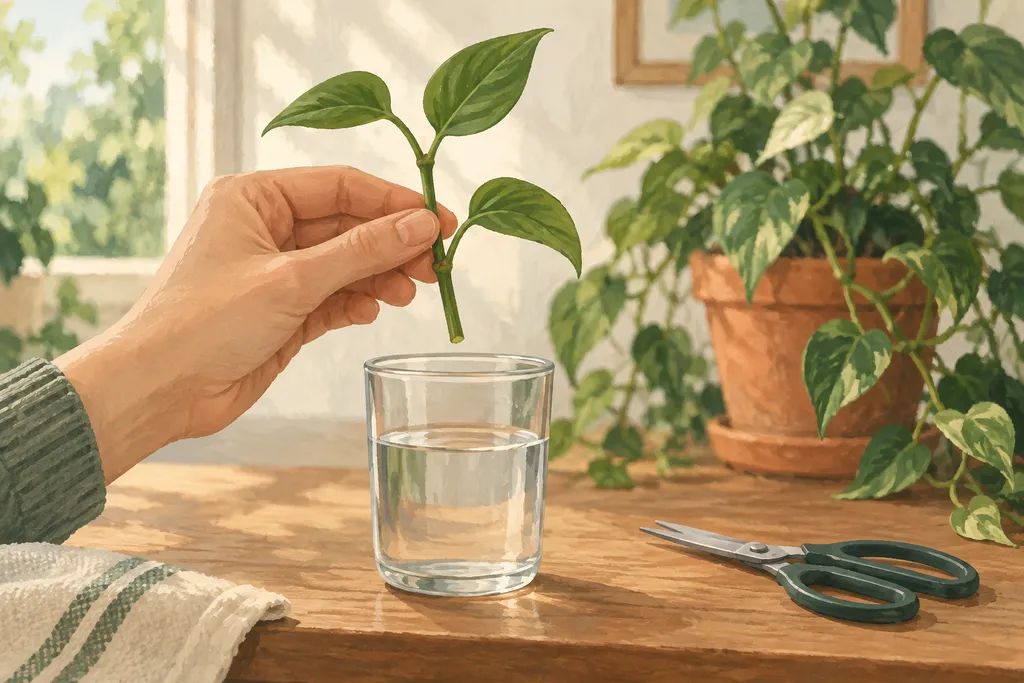
Washington State's handbook describes the classic stem-tip cutting: with a sharp, clean knife or pruners, cut the plant's stem just below the third or fourth leaf from the tip, then remove the lower leaves so the cutting has two leaf sets at the top. Iowa State (opens in a new tab) adds the preparation: water the parent plant the day before, use clean tools and containers — sterile potting mix, a pot with drainage — and keep everything washed, because the easiest failure is the one you smuggle in on a dirty blade.
- Water the parent plant the day before, so the cutting is well hydrated.
- Choose a healthy stem and cut just below a node — WSU places the cut below the third or fourth leaf from the tip.
- Remove the lower leaves, leaving about two leaf sets at the top — any leaf sitting under water or mix will rot.
- Optional: dip the cut end in rooting hormone — Iowa State notes (opens in a new tab) it speeds root formation but is not required; follow the label rate and never return used powder to the container.
- Set the cutting in moist rooting medium or plain water, node below the surface, leaves above.
- Keep it warm, humid, and bright but out of direct sun — Iowa State suggests (opens in a new tab) 65 to 75°F air and four to six hours of bright indirect light daily.
Iowa State's humidity instruction (opens in a new tab) is the piece most first attempts skip: maintain high humidity around the cutting with a plastic bag or dome — supported off the foliage and never sealed shut, since a little airflow keeps rot away. Expect slow, not instant: cane cuttings take roughly eight to ten weeks to produce roots and shoots in its telling, and stem-tip cuttings root over several weeks. Check moisture — keep the medium lightly moist, never waterlogged — and check rooting by gently probing beside the stem with a small spatula, as WSU advises, rather than pulling the cutting up to look.
Rooting in water versus in mix
Iowa State's stem-cutting guide (opens in a new tab) describes both honestly. Water rooting suits many easy plants — pothos, tradescantia, coleus — and has the advantage of visibility: you watch the roots form, change the water once or twice a week so the level never drops enough to expose them, and pot up when roots reach about an inch. Its drawback is brittleness: roots grown in water come out coarser and less adapted to potting mix, so a freshly potted cutting can wilt, drop leaves, or brown at the tips — consistent care over the following weeks is what carries it through.
Mix rooting skips that transition: WSU's recipe is equal parts perlite and peat or vermiculite and peat — a light, sterile, low-nutrient medium that drains — kept moist under a ventilated plastic bag in a warm, bright spot away from direct sun. The roots grow directly into the medium they will live in, which is why many extension guides quietly prefer it, and why cane plants that would rot in standing water belong in mix from the start. Either route works for easy plants; the honest trade is visibility now versus sturdiness later.
Leaf cuttings and division, at a glance
Two other methods cover the plants that will not cooperate with stem cuttings. Leaf cuttings suit species that generate plantlets from leaf tissue — Iowa State's examples include African violet (root a leaf with its petiole) and snake plant (sections of an upright leaf; note that variegated snake plants revert to green this way, and need division to keep the pattern). Cane cuttings suit plants with leafless, segmented stems — dracaena and dieffenbachia — laid or stood in mix with at least two nodes per section.
Division is the simplest cloning of all for plants that grow in clumps — ferns, peace lily, many palms. Iowa State's method: remove the plant from its pot, gently pull or tease the crown into sections that each carry leaves and roots, and pot each piece. It is also the method that doubles as repotting — the repotting guide covers getting a root-bound plant out of its pot without a fight.
Sap and toxicity note: Some houseplants — euphorbias, dieffenbachias, others — have sap that irritates skin; wear gloves and wash hands after cutting. And cuttings of toxic species are still toxic: keep them away from pets and children while they root — the pet-safe shortlist covers checking a plant before it shares your home.
When cuttings fail, and why
Most failures are quiet — the cutting sits, then softens at the waterline or base. The usual causes, drawn from what the sources warn against: rot from a waterlogged or unsterile medium, a cutting that carries no node — one snipped from a bare stretch of internode, or taken so high the node stayed on the parent — a parent plant too weak to donate, and winter timing when the plant was not actively growing. Iowa State's baseline applies to all of them — start from healthy, vigorous plants, in the growing season, with clean tools.
And some plants simply decline the offer: propagation success varies widely by species, which is why Iowa State keeps an 'easy' list — pothos, spider plant, snake plant, pilea, tradescantia — for early attempts. If a cutting fails, cut again rather than nursing rot: trim back to healthy tissue and take a fresh cutting that still carries a node below its leaves. A photo of a cutting that keeps failing can go to the plant doctor for a provisional read — AI-generated, a starting point — while the parent plant's own health is usually the better thing to inspect.
Sources and further reading
- Iowa State University Extension, Propagating Houseplants (opens in a new tab)
- Iowa State University Extension, How to Propagate Houseplants by Stem Tip Cuttings (opens in a new tab)
- Iowa State University Extension, How to Propagate Houseplants by Stem Section (Cane) Cuttings (opens in a new tab)
- Washington State University Extension, PNW Gardener's Handbook, Chapter 14: Houseplants (opens in a new tab)
- NC State Extension Gardener Handbook, Chapter 3: Botany (opens in a new tab)
Sources last checked 1 October 2026. Propagation success varies by species — the techniques here suit the plants the sources name, and uncommon plants may need species-specific instructions.
Spotted an error? Tell us — include the page URL and what looks wrong.