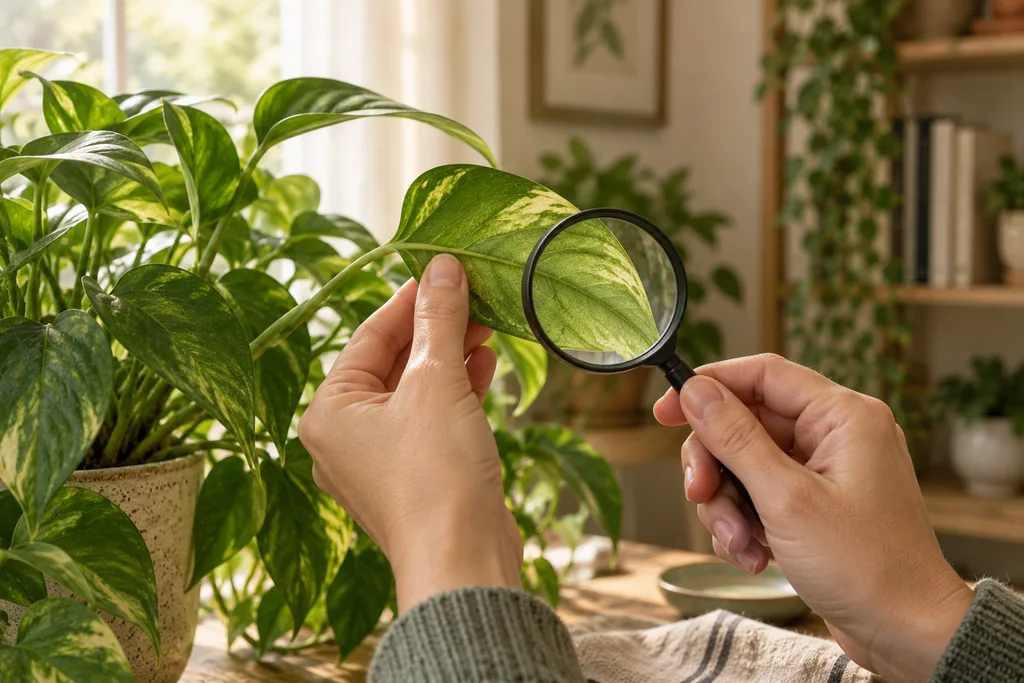
In brief
- Inspect before you treat — leaf tops, undersides, new growth, stems, and pots.
- A hand lens or close focus helps when the feature is tiny.
- Record exactly what you saw; identify the organism before acting.
- Move the plant away from others where practical if you find pests.
A plant can have a problem without a visible insect, and a marked leaf does not identify a pest. When you suspect one, begin with an inspection rather than a treatment. University of Minnesota Extension recommends early, regular checks of indoor plants. You are looking for direct evidence: an insect or egg, fine webbing, sticky residue, or a pattern of marks that tells you where to examine more closely.
Make a repeatable inspection route
Set the plant where you can see clearly. Look at the tops and undersides of several leaves, especially newer growth and affected areas. Follow stems to their joints and check around the pot rim. If the plant is dense, gently separate foliage without tearing it. University of Minnesota Extension calls out leaf undersides, new growth, stems, pots, insects, webbing, eggs, and sticky residue in its inspection advice. Read its indoor-insect guide.
- Leaf tops — the up-facing surfaces.
- Leaf undersides — lift a leaf and look beneath it.
- New growth — tender tips and leaf joints.
- Stems, the pot rim, and nearby plants.
Use a hand lens or the phone camera’s close focus if the feature is tiny. Photograph both the organism and the surrounding leaf when you can, but remember that Plant Says Hi accepts only one image in each analysis. Choose the sharpest frame for your main question and describe any additional view in the note. Do not put a pest name in the note unless you have actually identified it; “small pale moving specks beneath two leaves” is more honest and often more useful.
Separate an observation from an explanation
Sticky residue, webbing, holes, pale patches, and yellowing can prompt a closer look. They are not a species identification by themselves. Check whether you can see a living insect or another clear feature. Record which parts are affected, when you first noticed the change, and whether nearby plants show similar signs. The University of Minnesota Extension guide explains why early detection and identification matter before management.
If you find pests, move the plant away from nearby plants when practical while you identify what you found. Avoid shaking or brushing a heavily infested leaf over the rest of your collection. Minnesota Extension recommends isolating infested plants. See its quick facts.
Decide what to do only after identification
Different organisms and growing situations call for different responses. This guide does not recommend a pesticide or a universal treatment. If you plan to use a product, first identify the organism and follow locally applicable horticultural guidance and the product label. Regulations, available products, plant sensitivity, and indoor-use restrictions differ by country. For a valuable collection or persistent spread, contact a local extension service, garden adviser, or plant-health professional.
If you find no visible pest, keep observing rather than assuming that the plant is pest-free or that a symptom has one cause. Check moisture, light, and recent changes as well. A photo can show visible clues, but it cannot confirm what is hidden inside a leaf, stem, or root.
Keep a useful record
Write down the date, exact location on the plant, what you saw, and whether you isolated it. Example: “On the underside of three new leaves, tiny moving pale specks; one neighbouring plant checked, nothing visible.” A follow-up check can then tell you whether the pattern is changing. The goal is a better decision, not a dramatic label.
Takeaway: Inspect leaf surfaces, new growth, stems, and pots; record direct evidence; identify before treating.
Sources and further reading
- University of Minnesota Extension, Managing insects on indoor plants
- University of Maryland Extension, Tips for Submitting Photos to Ask Extension
Guidance checked 27 September 2026. Pest management must be matched to a confirmed organism and local product rules; this article gives observation steps only.