In brief
- Name what is moving before you treat it — the foliage pests guide covers leaves and stems; this one covers the pot and the air just above it.
- Fungus gnats point at wet, organic-rich mix: the answer is usually a drier habitat, not a spray.
- The flying adults are mostly a nuisance; the larvae in the mix are what occasionally matter, mainly for very young plants.
- Sticky cards count the adults. They cannot reach the larvae — drying the mix does.
Tiny flies drifting up from a houseplant, or something crawling in the mix, is a description before it is a problem. Clemson HGIC's pests factsheet (opens in a new tab) starts from the same place: identify the organism before choosing a response. The zone this guide covers is the one a leaf inspection skips — the potting mix surface and the air just above it.
What is actually moving: gnats versus other visitors
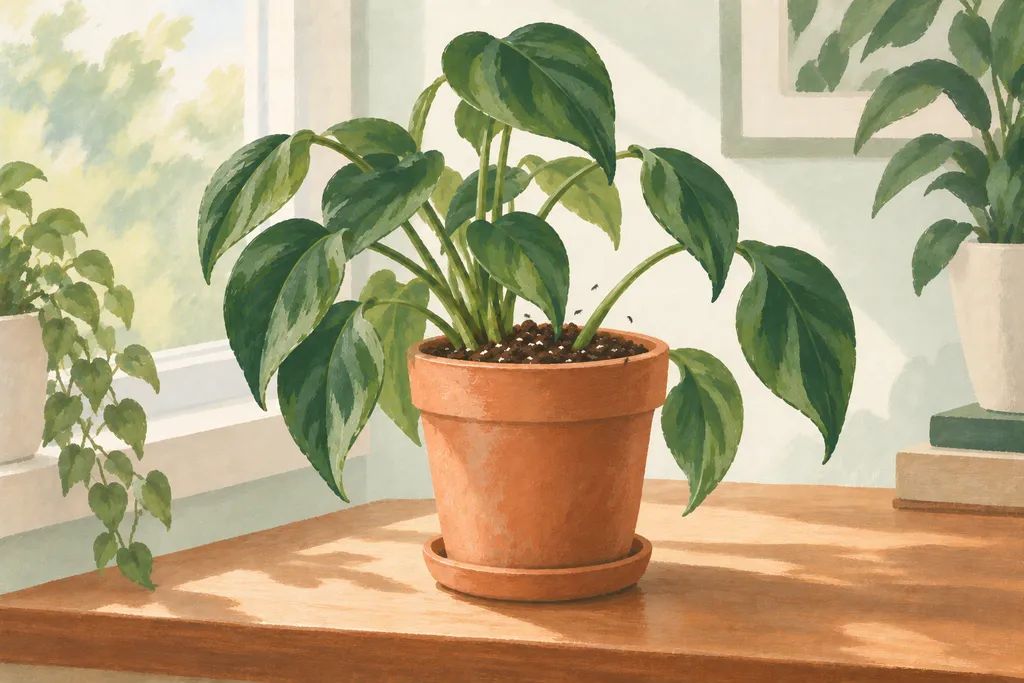
Clemson describes adult fungus gnats as delicate, roughly an eighth of an inch long, weak flyers attracted to light, often seen running across or flying near the soil surface under a plant. That last detail is the identifying one: gnats live their lives at the pot, not across the room. If what you saw rose from the soil surface and fluttered weakly toward the window, the description fits.
Other movers tell different stories. Whiteflies are small, powdery-white, and flutter up when the plant is disturbed — a foliage pest, covered in the visible-pests guide. Stockier flies circling a fruit bowl are likelier fruit flies, a kitchen matter rather than a potting-mix one. And movement inside the mix — crawlers, not flyers — may be the root-ball visitors Clemson lists for plants that summered outdoors: pillbugs, millipedes, slugs, or ants nesting in the medium.
Note where you saw it, how it moved, and how many. That three-part observation is enough to narrow the suspects before you change anything.
Why wet mix invites them
Clemson is specific about the conditions: fungus gnats are most often a problem in potting soil rich in organic matter, such as peat moss, and especially where overwatering occurs. The larvae feed on decaying organic material and fungi in the mix — both of which need moisture to keep coming. A pot that never dries is, from a gnat's perspective, a stocked habitat.
This is why the reading often doubles as a watering note: a mix wet enough to keep gnats fed is usually wetter than the plant needs. The watering guide covers the check-below-the-surface habit; WSU Extension (opens in a new tab) adds that watering from the bottom keeps the mix surface drier, which discourages fungus gnats, algae, and mold on top.
What the larvae do — and mostly don't
The honest split is between nuisance and damage. Clemson notes the adults do not feed on houseplants at all — they annoy people, not plants. The whitish larvae with shiny black heads live in the mix and mostly feed on decaying matter and fungi; the larvae of some species will also feed on roots, and that feeding is especially damaging to very young plants. On older, established plants the first sign is usually a loss of healthy appearance, and a heavily infested plant may drop leaves.
So the question to carry is not are there gnats but how many, for how long, and on which plants. A handful of adults near one moist pot after a wet week is a different situation from a cloud over every pot for a month — or a sudden swarm around seedlings, the case where the feeding genuinely bites.
Drying the habitat, not fogging the room
- Let the mix dry between waterings for plants that can tolerate it — most houseplants can, and Clemson notes dry conditions kill the larvae.
- Do not let water stand in the saucer beneath the pot; empty it after the pot has drained.
- Check neighbouring pots too: gnats move between plants, so one damp pot can keep the whole shelf supplied.
- For plants that summered outdoors and brought crawlers back in the mix, Illinois Extension suggests flushing pots with water to drive earwigs and ants out, and repotting if ants have settled in.
- If drying and hygiene do not settle it, products containing Bacillus thuringiensis subspecies israelensis are mixed into the soil for gnat larvae — Clemson's direction is to follow the product label for safe use, which is the right place for any insecticide decision.
What this is not: A promise of eradication. The goal is a habitat the gnats cannot use — the adults fade once the mix stops feeding larvae.
Sticky traps and what they can tell you
Yellow sticky cards sold for houseplants catch the flying adults that land on them. Stood at the soil surface, they answer one question well: how many adults are moving, and whether that number is rising or falling week to week. That trend is useful — a falling count says the drying is working before the pot looks any different.
What the cards cannot do is reach the larvae feeding in the mix, which is where the cycle actually lives. Treat a card as a scoreboard rather than the fix: it measures adults; drying the mix is what changes the habitat. If the count climbs despite drier conditions, the source may be a different pot — or a different insect, which is the next section's question.
When it's not gnats
If the insects sit on leaves rather than the pot, cluster on undersides, or rise in a white flutter when the plant is touched, you are looking at a foliage pest — the visible-pests guide runs that inspection. Crawlers inside the mix of a plant that summered outdoors are the root-ball visitors Clemson describes, often scraped away after unpotting or flushed out per Illinois.
And a plant that keeps declining after the mix has dried and the movers have been identified may have a different underlying problem — wilting on wet mix, for instance, points at the roots rather than the gnats, which the drooping-plant guide covers. When description and treatment stop lining up, take the record — what you saw, where, when, and how wet the mix was — to the plant doctor or to local horticultural advice.
Sources and further reading
- Clemson HGIC, Common Houseplant Insects & Related Pests (opens in a new tab)
- University of Illinois Extension, Tips for Moving Houseplants Indoors and Overwinter Care (opens in a new tab)
- Washington State University Extension, Chapter 14: Houseplants (PNW Gardener's Handbook) (opens in a new tab)
Sources last checked 1 October 2026. This guide helps you name and observe what is moving; insecticide choices and doses belong to product labels and local advice.
Spotted an error? Tell us — include the page URL and what looks wrong.