In brief
- Humidity is the water vapour in the air; dry heated rooms can push tropical plants past what their roots can replace.
- The dry-air sign is browning at leaf edges and tips — a clue shared with other causes, not a diagnosis.
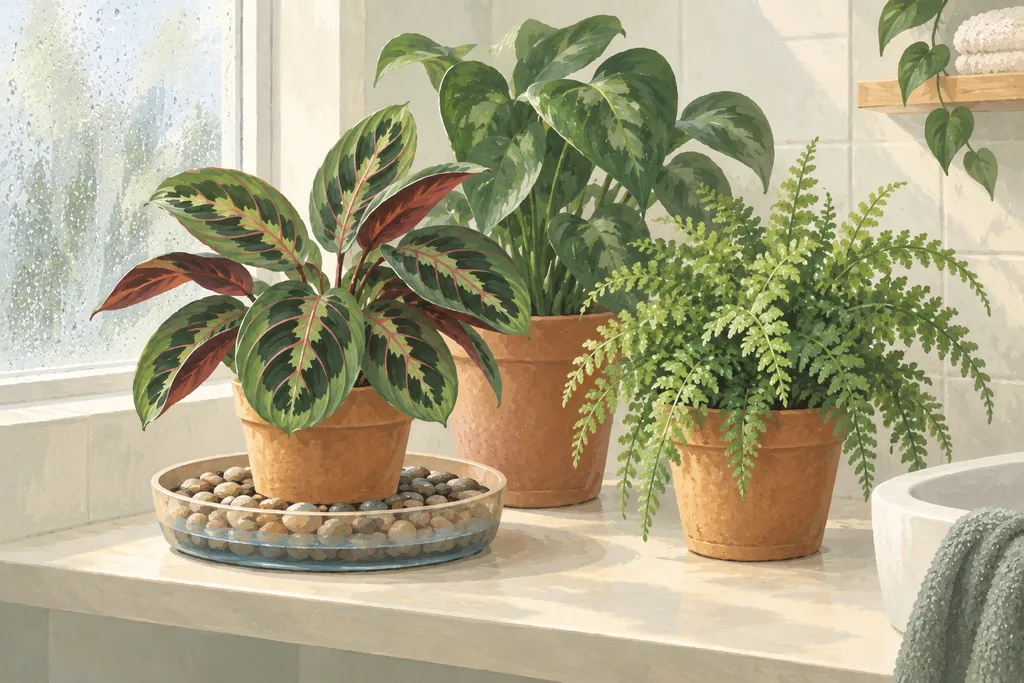
- Misting lifts humidity for minutes; grouped plants and a pebble tray help the plant; a humidifier changes the room.
- Measure before buying: a small humidity gauge tells you whether dry air is actually the problem in your room.
Humidity is the concentration of water vapour in the air, and the RHS notes (opens in a new tab) it matters because it drives transpiration — the flow of water through the plant. In drier air, leaves lose water faster and the roots must keep pace or the plant wilts. Most of the houseplants we keep are forest-floor tropicals, which is why the question comes up so often — and why the honest answer is "it depends which plant".
What humidity is, in one paragraph
Relative humidity is a percentage — how much water vapour the air holds compared to the most it could hold at that temperature. Warm air holds more, which is why a heated winter room reads so dry. The numbers differ by source: Nebraska–Lincoln Extension (opens in a new tab) puts a comfortable room for people at 30–50% and notes many plants do best nearer 70–80%, while Illinois Extension (opens in a new tab) finds most houseplants grow normally at 40–50%. Either way, a heated winter room can fall far below both.
When the air is drier than the plant likes, transpiration outruns the roots and the damage shows at the leaf's edges — the tissue furthest from the water supply. Nebraska–Lincoln names the sign: drying and browning leaf edges and tips.
Which plants actually notice dry air
Nebraska–Lincoln splits houseplants into a useful pair of lists. Plants that appreciate higher humidity include ferns, rex begonias, prayer plants, and calatheas — natives of rainforest floors and riverbanks. Plants that tolerate low humidity include cacti and succulents, cast iron plant, Chinese evergreen, pothos, philodendron, and dracaena.
- Crisp, brown tips and edges on thin-leaved tropicals are the classic dry-air pattern — though the brown-tips guide is clear that several causes share that clue.
- A plant doing fine for months can struggle when the heating season starts — the winter guide covers that swing; Illinois measured winter indoor humidity below 20%.
- Low humidity is also the condition spider mites thrive in — one more reason dry air deserves a check before a purchase.
What misting does — for about five minutes
Misting feels like it should work: a cloud of water vapour lands right on the leaves. Illinois Extension tested it with a digital gauge and found the benefit evaporated within minutes — a pebble tray, by contrast, releases moisture slowly over hours. Nebraska–Lincoln puts it more bluntly: to matter, misting would need to happen every few minutes, and continual leaf wetness brings its own problems — Nebraska–Lincoln and WSU both flag leaf-spot disease risk on wet foliage, so if you mist at all, do it early enough that leaves dry by nightfall.
This is one of the myths the myths guide retires: misting feels thorough but barely registers on a gauge. The practical answer works at larger scales.
Grouping, trays, and humidifiers by scale
- Grouping — cluster plants together and their transpiration pools into a slightly more humid pocket of air. Nebraska–Lincoln and WSU both recommend it; it costs nothing and helps every plant in the cluster.
- Pebble tray — a shallow tray an inch or two deep, a layer of gravel, and water kept below the pot's base. Nebraska–Lincoln's mechanics matter: the pot never sits in the water, or the roots rot; refill as the water evaporates. It humidifies the plant, not the room.
- Humidifier — the only method that changes the room rather than just its corner. Nebraska–Lincoln notes small appliances attach to a heating system or stand alone; Illinois suggests moving plants nearer a room humidifier when the heating season starts.
- A cover — a bell jar, cloche, or even a clear bag tents one plant in its own humid air. Nebraska–Lincoln lists it for single plants that need the most.
Bathrooms, kitchens, and other wet rooms
The cheapest humidifier is a room that already makes steam. Nebraska–Lincoln and the RHS both point to bathrooms and kitchens as the naturally humid rooms — a real option for the plants on the humidity-loving list, if the room has enough light. Nebraska–Lincoln also lists what to avoid placing plants near: outside doors, radiators, and heating vents, where draughts and blasts of hot dry air undo the benefit.
Measure before buying
Before buying a humidifier, buy a gauge — Illinois' author uses a small digital thermometer-and-humidity meter, and notes they are inexpensive. Watch the number across a few ordinary days and nights. If the room sits in a range your plants tolerate, the brown tips you were chasing have another cause; if it truly runs dry, you now know how dry — and a humidifier becomes a decision rather than a guess.
- Check the reading a few times across a few days — mornings and evenings differ.
- Compare it against the plants you actually keep — tolerant lists versus humidity-lovers.
- Start with the free fixes — grouping, a wet room, moving plants off draughts — before the appliance.
Keep it proportionate: Humidity is one input among several. If the leaves brown only at the tips, check the mix and the light too — the symptom is shared, so the check should be as well.
Sources and further reading
- University of Nebraska–Lincoln Extension, Success with Houseplants — Humidity (opens in a new tab)
- University of Illinois Extension, How to Overwinter House Plants (opens in a new tab)
- Washington State University Extension, PNW Gardener's Handbook, Chapter 14: Houseplants (opens in a new tab)
- Royal Horticultural Society, Choosing the best houseplants (opens in a new tab)
Sources last checked 1 October 2026. Sources give different ideal humidity bands for different plant groups — treat any number as a range to compare against your own room, not a target to hit.
Spotted an error? Tell us — include the page URL and what looks wrong.