In brief
- Winter's real change is the light: fewer hours, a lower sun — the same window delivers less, and growth slows in response.
- Check the mix before watering, less often than in summer — but still by feel, not by a new calendar.
- Hold off on feeding and repotting until growth resumes unless something is clearly wrong.
- Dry heated air, draughts, and leaf drop are the season's other inputs — a short check routine catches them.
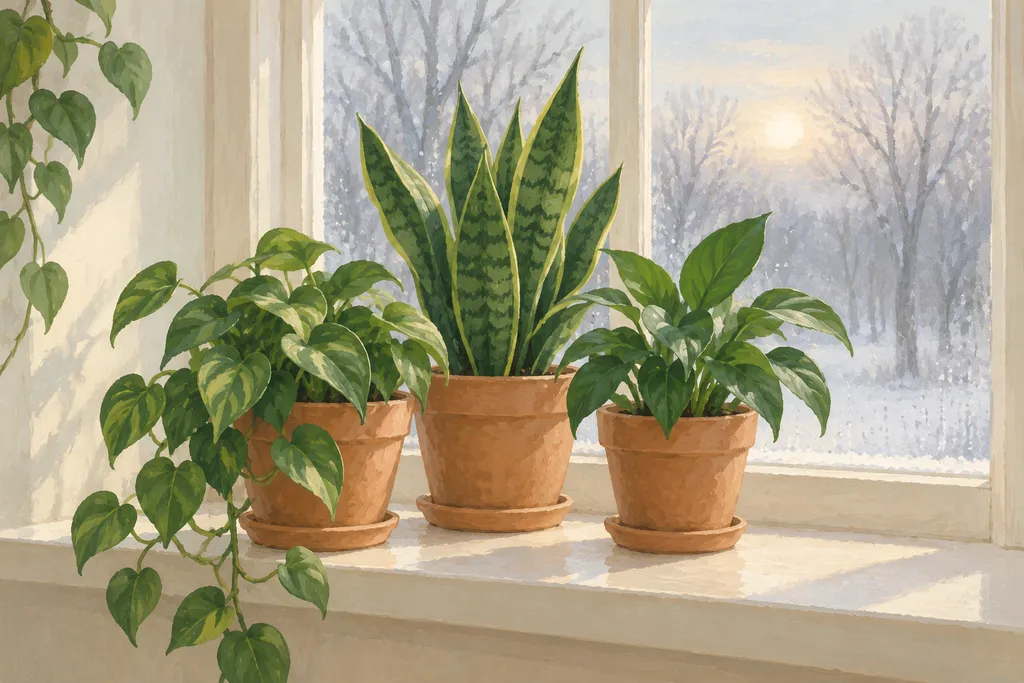
Winter changes the inputs a houseplant lives on: the days shorten, the sun sits lower, and heated rooms turn dry. Illinois Extension calls light (opens in a new tab) the most important — and most limiting — factor for houseplants in winter, and UVM Extension describes (opens in a new tab) the plant's response as quiescence: a resting state where growth slows rather than stopping. Seasons differ across hemispheres, so read "winter" as your own low-light months.
Shorter days change the inputs
Two things shift at once. The total light arriving falls — shorter days, a lower sun angle — while bare outdoor trees can actually let more direct sun through a window that was shaded in summer. Illinois Extension warns (opens in a new tab) that summer's filtered-light windows can become nearly full sun once shade trees lose their canopy, and that the light reaching your plants can change more than you realize. A spot that was comfortably bright-indirect in summer may turn dim, or unexpectedly sharp, in winter.
The light guide covers how to read the spot. If a plant now leans, or new leaves come in small on thin stems, those are the classic low-light signs Illinois lists — the leggy-plants guide reads that pattern in detail. Illinois also notes that supplemental light can compensate, and it can be as simple as a lamp.
Water: check less often, not a new schedule
Slower growth means slower water use, so the mix stays wet longer and watering gaps naturally stretch out. Illinois Extension's rule of thumb (opens in a new tab) is that more houseplants die from over-watering than under-watering in winter — the response is to check less often, not to water by a reduced schedule.
Feel the top inch or two of the mix before watering, or lift the pot — Illinois notes a plant ready for water may weigh half as much as it does just after watering. UVM adds the chopstick test: push a wooden chopstick to the bottom of the pot and pull it out — clean and dry means water, soil stuck to it means wait. When the mix is dry at depth, water thoroughly and let the excess drain. The watering guide works through the checks.
Feeding and repotting can wait
With growth slowed, UVM advises holding off on fertilizer and repotting unless something is clearly wrong — both inputs land better once the plant is actively growing again. The feeding guide explains what the pause is resting and how feeding resumes. Penn State puts repotting in spring (opens in a new tab) for the same reason: that is when the plant naturally resumes seasonal growth. The repotting guide covers the how; for now, a root-crowded but healthy plant can simply wait.
Dry heated air, draughts, and temperature
Central heating dries a room — Illinois measured winter humidity (opens in a new tab) falling below 20% relative humidity, well under the 40–50% most houseplants prefer. A room humidifier, plants grouped together, or a pebble tray held below the pot base all raise the air's moisture; misting's effect evaporates in minutes. The humidity guide compares the methods by scale.
Temperature is steadier than it feels, but avoid the extremes: Illinois suggests roughly 65–75°F days and a night-time drop of about 10 degrees, and keeping plants clear of cold draughts, icy windowpanes, heat vents, and radiators. UVM adds woodstoves and heating vents to that list — and warns that spider mites thrive in low humidity, so a dusty-leaf wipe does double duty as a pest scout.
Leaf drop: normal versus not
Some leaf drop in winter is the quiescence itself — UVM lists alocasias and caladiums as plants that may lose leaves under reduced light and rebound in spring. Maryland Extension notes weeping figs are famous for dropping leaves simply because they were moved to lower light. If older leaves yellow and fall while new growth stays small and thin-stemmed, that is the light-hunger pattern from the leggy guide — not a verdict of doom.
What still deserves a check is the usual list: sudden drops with wet mix, new yellowing at the crown, or wilting that a drink does not fix. The yellow-leaves guide reads the colour patterns; winter does not excuse them.
A simple winter check routine
None of this needs a new regime — the routine shrinks to a few checks, run on your own rhythm:
- Look at the light reaching the leaves over a few days, not just at noon — notice whether the sunbeam reaches the spot now.
- Feel the mix an inch or two down before watering; lift the pot to learn its dry-versus-wet weight.
- Wipe dust from leaves with a damp cloth — UVM notes clean leaves absorb more light, and the wipe doubles as a pest check.
- Glance for the dry-air signs — brown tips, a spidery haze — and note anything that changed.
If you keep one note, keep this one: Jot the date you watered and one observation — "leaned left", "dropped two lower leaves". A season of small notes reads better than memory.
Sources and further reading
- University of Vermont Extension, Houseplant Care During the Winter Months (opens in a new tab)
- University of Illinois Extension, How to Overwinter House Plants (opens in a new tab)
- University of Illinois Extension, Make Sure Houseplants Get Enough Light This Winter (opens in a new tab)
- University of Maryland Extension, Lighting Indoor Plants (opens in a new tab)
- Penn State Extension, Repotting Houseplants (opens in a new tab)
Sources last checked 1 October 2026. Seasonal guidance flips with the hemisphere — apply the ideas to whichever months are your short, low-light ones.
Spotted an error? Tell us — include the page URL and what looks wrong.