In brief
- "Potting mix" for houseplants usually contains no soil at all — it is a blend built to hold air and water together.
- A drainage hole matters more than any layer inside the pot: water needs a way out or roots sit wet.
- A cachepot is a sleeve, not a planter — the plant lives in a holed inner pot, and the outer one gets emptied.
- When mix stays wet, shrugs water off, or grows a salt crust, the medium itself is the problem.
The thing under the plant decides what watering even means. Clemson HGIC (opens in a new tab) lists what a quality container mix has to do at once: support the plant, hold nutrients, let water and air pass through, retain moisture, and arrive free of pests and disease. That is a hard balance for plain ground to strike, which is why the bagged product is engineered rather than dug.
What potting mix actually is
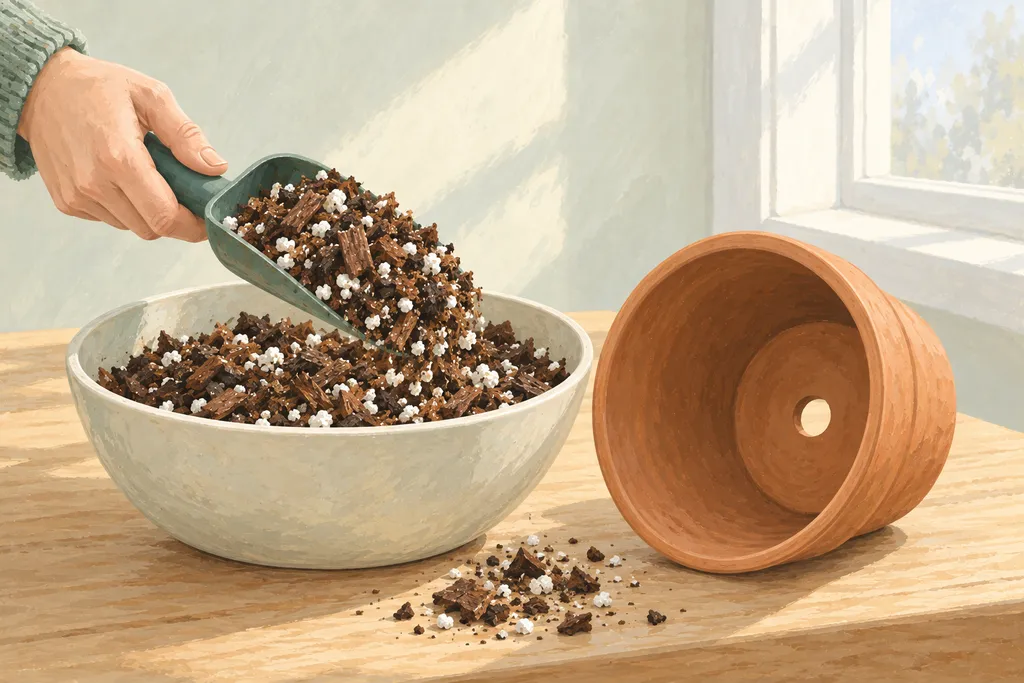
Most houseplant mixes are soilless — Clemson notes "artificial" potting media contain no soil at all. WSU Extension (opens in a new tab) describes the recipe: an organic fraction (peat moss, coir, ground bark) plus an inorganic fraction (perlite, vermiculite, sand). The organic part holds moisture and nutrients; the chunky inorganic part keeps air spaces open. Clemson calls the peat-plus-perlite-or-vermiculite blends "peat-lite" mixes — the most common type on the shelf.
Two things worth knowing: coir — coconut fibre — is the lower-cost, more sustainable swap for peat that Clemson notes, though it should be rinsed before use to flush out residual salts. And garden soil stays outside: both WSU and Clemson warn it brings clay that smothers drainage plus weed seeds and soil-borne disease the indoor pot cannot afford.
Why holes beat gravel
A pot needs an exit. WSU lists drainage holes (opens in a new tab) among the qualities a container must have and calls containers with no drainage "not good flower pots" — spare water has to leave, or it pools around roots that also need air. Penn State (opens in a new tab) suggests drilling holes in a pot you want to keep, or pairing it with a saucer or drip tray that is emptied after watering.
What about the classic fix — a layer of gravel at the bottom? It does not work the way the intuition says. Water perches above the layer instead of draining into it, so the gravel raises the wet zone rather than removing it. The myths guide shows the physics; the takeaway here is simpler — a hole and a free-draining mix do the job the gravel was supposed to.
Matching mix texture to the plant
Clemson describes two classic textures from Cornell's mix research: a foliage mix — peat-heavy, built to hold even moisture — and an epiphytic mix, built around bark for plants that naturally grow perched on trees or rocks. The bark-heavy blend suits bromeliads and plants like monstera, philodendron, and peperomia; cacti and succulents get the coarsest, fastest-draining version.
- Match by plant group, not by brand claims: moisture-holding "houseplant" mixes for foliage plants, barkier epiphytic blends for aerial-rooted plants, gritty mixes for cacti and succulents.
- WSU notes self-watering pots need a light mix — about half perlite — because a dense one wicks too much water and suffocates roots.
- Peat-based mixes resist re-wetting once they dry completely — the old-mix problem below covers the fix.
Cachepots and double-potting, done safely
The decorative pot without a hole is a cachepot — Penn State also calls it a potholder or overpot. It is a sleeve: the plant grows in a plain inner pot with drainage, which slips inside. Penn State's two rules: leave a space between the inner pot's drainage hole and the cachepot's base, and remove the excess water that collects after watering.
Material is part of the choice too. Penn State notes unglazed terracotta is porous — it pulls water and salts out of the mix, which reduces waterlogging (ideal for succulents) but means more frequent watering. Plastic and glazed ceramic hold moisture longer; ceramic often lacks a hole, which makes it a cachepot by default.
When the mix itself is the problem
Old mix fails in two visible ways, and WSU names both. The first is a salt crust: a white-to-yellow deposit on the surface, a ring at the drainage hole, or a bloom on the outside of porous clay. Concentrated salts make water harder for the plant to take up and can kill root tips; WSU suggests leaching — running water through the pot — every four to six months, using roughly twice the pot's volume, and letting about a tenth of each regular watering drain.
The second is a mix that has gone water-repellent. Peat-based blends can shrink as they dry and pull away from the pot walls, so water runs straight down the gap and out the bottom without wetting anything. WSU's fix is mechanical: immerse the whole pot in a pail of water until the bubbles stop rising. If the mix keeps failing — stays wet for days, sheds water, or crusts — that is a repotting decision, and the repotting guide covers it.
Reading the bag before buying
The label vocabulary is small once you know it. "Potting mix" or "soilless" signals the engineered product for containers — Penn State recommends it over anything marketed as garden soil or topsoil. The ingredients list reads like the recipe above: peat or coir for the organic part, perlite or vermiculite for the air spaces, bark for texture.
- Check whether the bag already includes fertilizer — Clemson notes many mixes carry a slow-release feed that covers the first months, so adding your own right away can double the dose.
- Skip products meant for the ground — garden soil and topsoil are for beds, and the indoor pot needs the soilless version.
- Match the texture to the plant group — the section above — rather than the photograph on the bag.
The two-second check: Tip the pot and look at the bottom. If there is a hole, the watering rhythm has somewhere to go. If there is not, the pot is a cachepot or a problem — and the fix is a drill, a sleeve arrangement, or a different pot.
Sources and further reading
- Clemson University HGIC, Indoor Plants: Soil Mixes (opens in a new tab)
- Penn State Extension, Repotting Houseplants (opens in a new tab)
- Washington State University Extension, PNW Gardener's Handbook, Chapter 14: Houseplants (opens in a new tab)
Sources last checked 1 October 2026. Mix names vary between brands — read the ingredients and the texture rather than the label's promise, and match it to the plant group.
Spotted an error? Tell us — include the page URL and what looks wrong.