In brief
- A calendar can remind you to check — it cannot decide for the plant.
- Check the potting mix below the surface, for this plant and this medium.
- Let a conventional pot drain, then empty the saucer or cover pot.
- Note what you observed before changing anything else.
“Water every Sunday” sounds simple, but a pot can dry at a different pace when the light, temperature, growth, or potting mix changes. A fixed day may be a good reminder to check. It is a poor substitute for finding out whether water is needed. University of Maryland Extension cautions against a fixed schedule, and the Royal Horticultural Society recommends checking moisture below the surface.
Check below the surface
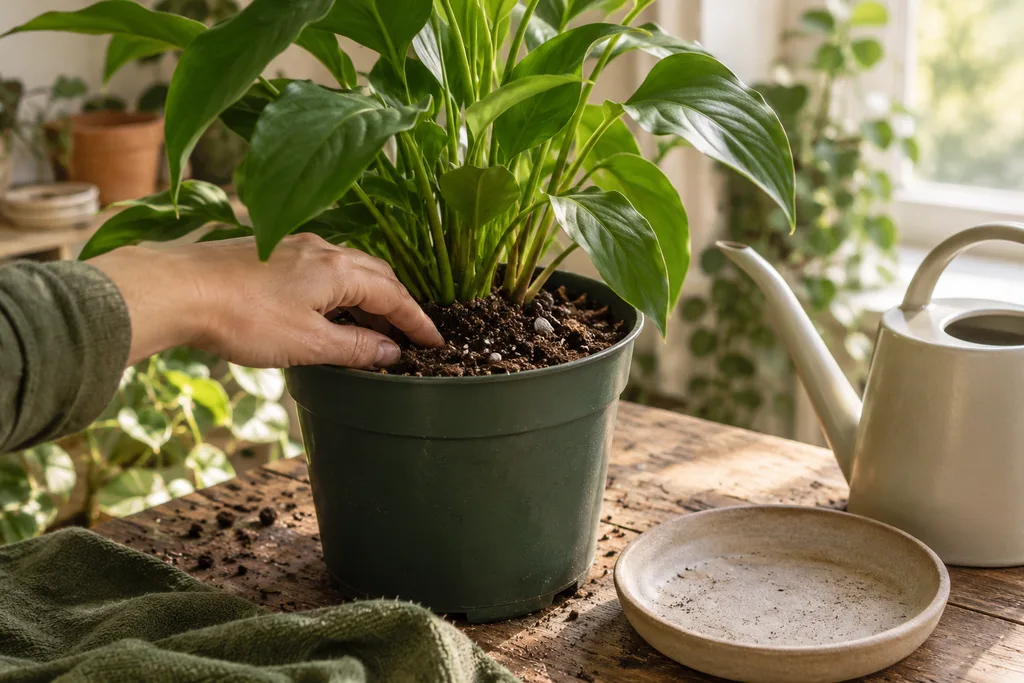
Look at the plant and feel the growing medium a little below its surface before reaching for the can. The top layer can look dry while the mix beneath it remains damp. The RHS suggests checking a few centimetres down; Maryland Extension also describes a finger test for many common houseplants. Neither source gives one threshold that works for every species or growing system. Cacti, succulents, orchids, mounted plants, and terrariums need their own guidance. RHS · Maryland Extension
If the mix still feels damp at the depth you check for that plant, pause and check again later. If it feels dry and the plant’s needs point to watering, water thoroughly enough for the conventionally potted plant to drain. Lift the pot before and after watering if it is safe to do so; its weight can become another familiar clue, though it is not a calibrated moisture reading.
A useful reminder: “Check the pot on Sunday” leaves room for what the plant actually needs. “Water every Sunday” does not.
Watch where the extra water goes
For a standard container with drainage holes, let water move through the growing medium and out of the base. Empty water that collects in the saucer or cover pot after drainage. A decorative outer pot can hide standing water, so lift the inner pot to check. Both Maryland Extension and the RHS advise letting excess water leave and checking for collected water.
If water immediately runs down a gap at the pot edge or the mix repels it, the visible runoff does not by itself prove that the root zone is moist. Check the growing medium itself and follow plant-specific advice before adding more. Do not add water repeatedly just to meet a fixed volume: pot sizes and media differ.
Read the whole setting, not one symptom
Drooping or yellowing can occur with different watering problems and with other changes. Check the mix, drainage, light, temperature, and recent moves together. The RHS overview of a poorly houseplant begins with these practical conditions rather than treating a leaf colour as a diagnosis. A plant may use water at a different pace as its light and growth change. The right response is to observe again, not automatically to shorten or lengthen a calendar interval.
Try a two-line record for a week or two if you feel unsure: “27 Sep: mix damp below surface, no water; pot still heavy” and later, “1 Oct: mix drier, watered and emptied saucer.” The record helps you notice this plant’s pattern in this room. It is not a universal recipe.
A calm check before you decide
- Identify the plant if possible and look up its specific needs.
- Check moisture below the surface using a method appropriate to its growing medium.
- Make sure a conventionally potted plant can drain and is not sitting in runoff.
- Notice light, temperature, growth, and any recent change.
- Water only when those observations support it, then note what happened.
If several leaves change or the plant continues declining despite careful checks, seek locally appropriate horticultural advice. A photo alone cannot tell you the moisture state of the whole pot or diagnose a root problem.
Sources and further reading
- Royal Horticultural Society, How to help a poorly houseplant
- University of Maryland Extension, Watering Indoor Plants
Guidance checked 27 September 2026. Adjust for species and growing system; this guide describes conventional potted houseplants with drainage.