In brief
- Care tags and guides reuse a small vocabulary — learn the two dozen words that matter and the rest of the advice reads plainly.
- "Bright indirect" describes a position — a bright room, out of the sunbeam — not a compass direction.
- "Root bound", "well-draining", and "cachepot" are about what the roots sit in; each has a simple check.
- "Easy", "hardy", and "pet-safe" are marketing shorthand, not guarantees — the plant's name and its conditions still decide.
Plant tags and care articles lean on the same couple of dozen terms, and most confusion comes from four families of words: light, water, pots and roots, and time. This glossary defines the words the way horticulture uses them — drawing on NC State Extension's botany chapter (opens in a new tab), the RHS houseplant guide (opens in a new tab), and university extension factsheets — and says what each word asks you to look at.
Light words: bright indirect, low light, and direct
Light words cause the most confusion because they describe a position, not a setting. The RHS groups indoor light (opens in a new tab) into full sun, bright indirect light, and shade, while Maryland Extension (opens in a new tab) measures the same idea in foot-candles. Both are describing where the plant sits relative to the window, not the window's compass direction.
- Bright indirect light — a bright room where the sun's beam does not land on the leaves. Maryland's medium-bright and high tiers, roughly 100 to 1,000 foot-candles, cover most of what tags mean by it. The find-the-right-light guide shows how to read it at your own window.
- Low light — "tolerates a dimmer spot", not "needs no light". Maryland's low tier runs about 25–100 foot-candles, and Illinois Extension describes low light as a north window area or a position well away from any window. No common houseplant thrives in a dark corner.
- Direct sun or full sun — the sunbeam itself reaches the leaves for part of the day. For scale, Maryland puts outdoor direct sunlight near 10,000 foot-candles, far above any indoor spot. The RHS warns that strong summer sun through glass can scorch some foliage unless a curtain filters it.
Water words: well-draining, damp, and leaching
- Well-draining — a mix that lets water and air pass through while still holding enough moisture for roots. It describes the medium in the pot, not how often you water; Clemson HGIC lists the qualities (opens in a new tab) a good container mix needs.
- Damp, wet, and dry — judgements made below the surface, not on it. The top centimetre can look dry while the mix beneath is still wet, which is why the watering guide checks at depth.
- Evenly moist — consistently damp rather than cycling between soaked and bone-dry. It is a target range for the plant, not an instruction to keep the mix wet.
- Leaching or flushing — running extra water through the pot to wash accumulated salts out of the mix. WSU Extension's houseplant chapter (opens in a new tab) suggests flushing every four to six months and letting a fraction of each watering drain away.
When a tag says "keep moist" or "allow to dry between waterings", it is describing a rhythm to check against — a reminder to feel the mix, not a schedule to obey.
Pot and root words: root bound, drainage hole, cachepot
- Root bound or pot-bound — roots circle the root ball or pack it so densely that mix barely shows in the bottom third. That is Penn State Extension's check (opens in a new tab), and the repotting guide works through the other signs.
- Drainage hole — the opening in the pot's base that lets spare water leave instead of pooling around roots. WSU Extension counts it (opens in a new tab) among the qualities a container needs.
- Cachepot — the decorative outer pot, usually without a hole. Penn State calls the same thing a potholder or overpot: the plant lives in a holed inner pot slipped inside it, and standing water in the cachepot is emptied after watering.
- Saucer or drip tray — the shallow dish under a pot that catches runoff; it is emptied after watering, not left full.
Leaf and stem words: node, internode, petiole, margin, variegated
These are anatomy words, and NC State's botany chapter (opens in a new tab) defines the set. They matter because so much plant advice hangs on them: cuttings root at nodes, stretching happens in internodes, and identification keys start at leaf shape and margin.
- Node — the point on a stem where a leaf attaches; the node carries a bud, so it is where new growth can start.
- Internode — the stretch of stem between two nodes. Long internodes are the "stretching" behind leggy growth — NC State notes too little light produces them, a process it calls etiolation. The leggy-plants guide reads that shape.
- Petiole — the stalk that holds the leaf blade away from the stem, attaching at the node.
- Margin — the leaf's edge: smooth (entire), toothed, or lobed. Together with shape it is one of the features a name check relies on — the identification guide uses it, and the photo guide shows how to frame it clearly.
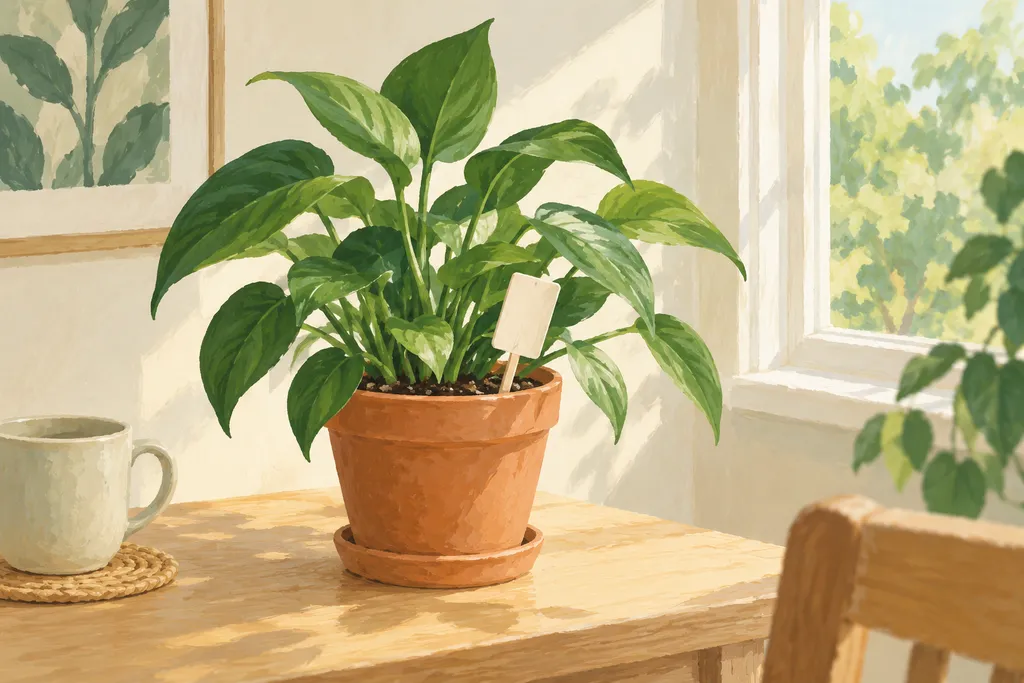
- Variegated — leaves marked with more than one colour zone, often cream, white, or gold. The word describes the foliage's look, not how tough the plant is.
Time words: dormant, quiescent, growing season
- Growing season — the months when the plant actively grows, roughly the longer, brighter part of the year. It shifts with hemisphere and with indoor conditions, so "feed in the growing season" means watch for growth, not a fixed month.
- Dormant — a resting state where growth pauses. NC State ties dormancy to temperature and season; outdoors it often means surviving cold.
- Quiescent — the milder version houseplants do indoors: UVM Extension describes (opens in a new tab) plants conserving energy as growth slows under shorter days. Some, like alocasias, may drop leaves and rebound in spring — the winter guide covers the season.
Words to be careful with
Some tag words are shorthand for a sales pitch rather than a botanical fact. Read them as "under the right conditions", then check what those conditions are.
- Hardy — an outdoor word meaning the plant survives cold. For a windowsill plant it says nothing about indoor life; NC State uses "nonhardy" for plants harmed by low temperatures.
- Easy or low-maintenance — a comparison, not a property. Even the RHS "easy-care" picks (opens in a new tab) assume you match the plant to the room's light and temperature first.
- Pet-safe or pet-friendly — no shared standard stands behind these phrases. The reliable check runs on the plant's actual name against a veterinary list — the pet-safety guide walks through it.
The habit worth keeping: A tag word describes a tendency. The plant's response in your room — and the checks in these guides — is what settles it.
Sources and further reading
- NC State Extension Gardener Handbook, Chapter 3: Botany (opens in a new tab)
- Royal Horticultural Society, Choosing the best houseplants (opens in a new tab)
- University of Maryland Extension, Lighting Indoor Plants (opens in a new tab)
- University of Illinois Extension, Make Sure Houseplants Get Enough Light This Winter (opens in a new tab)
- Clemson University HGIC, Indoor Plants: Soil Mixes (opens in a new tab)
- Penn State Extension, Repotting Houseplants (opens in a new tab)
- Washington State University Extension, PNW Gardener's Handbook, Chapter 14: Houseplants (opens in a new tab)
- University of Vermont Extension, Houseplant Care During the Winter Months (opens in a new tab)
Sources last checked 1 October 2026. Definitions follow the botanical usage in the sources; tag wording varies between sellers, so check what each phrase means for the plant in front of you.
Spotted an error? Tell us — include the page URL and what looks wrong.